
Checking for a Warrant in Crowley County
Start with the office that actually holds the answer. For a county or district case in Crowley County, that office is the Crowley Combined Court. Its clerk can pull up the case, tell you which documents are public, and confirm whether a status question belongs there or somewhere else. Before you call any office, have the full legal name, the case or citation number, and the issuing agency written down. It saves a trip and a second phone call. The route also depends on who wrote the ticket. Crowley city citations go to Municipal Court, while Colorado State Patrol and county-sheriff citations go to Combined Court. The Sheriff answers law-enforcement and custody questions, but only the court can say whether its warrant is still active, recalled, or sealed. The state docket adds hearing context, though it stops short of being a warrant database. If a warrant might exist, get legal advice before walking into a courthouse or jail in Crowley County.
- Identify the issuing agency and whether the matter is county, district, or municipal.
- Search the Colorado Judicial docket for hearing and case context, not final warrant status.
- Ask the Combined Court clerk or Crowley municipal court to confirm the current order.
- Call the Sheriff for service, detention, or custody questions, or submit a focused records request.
- If the court confirms a warrant, consult counsel about the proper appearance, motion, or bond step.
Crowley County Sheriff Warrant Gallery
The Crowley County Sheriff gallery is an official publication. It offers no name box, case field, warrant type, status filter, or update date. Colorado also publishes no single statewide warrant roster. Those limits matter when you search. A blank gallery does not prove that no warrant exists, and a photo posted there may lag behind a recent recall.
Use the fallback chain: contact the issuing court, check the state docket for context, call the Sheriff at 719-267-5555 for the proper law-enforcement route, and request a releasable record when needed.
Treat the official Crowley warrant page as one signal among several. Do not copy its names, photos, addresses, or case details into another roster. For the current status of any Crowley County warrant, the issuing court is the only office that can confirm whether it is active, served, recalled, cancelled, sealed, or restricted.
Crowley County Warrant Types
A warrant's label tells you its purpose, never its current status. An arrest warrant usually starts when a judge finds probable cause. A bench warrant can follow a missed hearing or ignored court direction. A search warrant authorizes a search and follows different disclosure rules. Colorado sources favor the phrase bench warrant over capias for failure-to-appear orders. Municipal warrants come from a town ordinance case. Whatever the type, the issuing court verifies it.
| Warrant Type | How It Arises | Who Issues It |
|---|---|---|
| Arrest warrant | Authorizes an arrest after the required judicial finding. | A Colorado judge |
| Bench warrant | May follow a missed appearance or failure to obey an order. | The judge handling the case |
| Search warrant | Authorizes a defined search, not a general arrest. | A judge with legal authority |
| Failure-to-appear warrant | May follow a missed summons or required court date. | The issuing judge |
| Municipal warrant | Comes from a city-code, parking, or municipal traffic matter. | Municipal Warrant |
Crowley County Warrant Court Routes
Crowley Combined Court sits in Colorado's 16th Judicial District along with Bent and Otero Counties. County Court handles most misdemeanor, traffic, and failure-to-appear matters, while District Court takes felonies and other district-level cases. Both work out of the same local combined courthouse, where the Clerk of Court keeps the case records. The published Crowley court phone is 719-267-4468. Call that office first about a Crowley County warrant check. Town courts play a narrower role. Ordway, Olney Springs, Sugar City, and Crowley each lack a dedicated warrant portal. Sugar City's official code does confirm a municipal court and concurrent Sheriff jurisdiction, but that overlap does not merge into one shared database. Before contacting Crowley Combined Court, ask the town clerk whether your matter is municipal or state.
Inside a Crowley County Warrant Record
A releasable Crowley County warrant record can name the court, the case or citation number, the document type, the issue date, the alleged charge, any bond or release condition, service language, the next hearing, and a later recall entry. Those pieces often sit split between a register of actions and a signed order. Not every field is public. An index entry is not the warrant itself. The example below is a format guide only, not a real record.
| Record identifier | A case, citation, or document number, such as CASE-NUMBER; no local warrant-number format was confirmed. |
|---|---|
| Subject identifiers | Name and other identifiers may be limited or redacted; use only what the custodian requests. |
| Charge or violation | The allegation tied to the case, not proof of guilt. |
| Issuing court | The office that controls the order and any recall or quash action. |
| Bond | A financial or nonfinancial release condition, separate from warrant status. |
| Status and date | Active, served, recalled, quashed, or restricted language must be read as of a stated date. |
Crowley County Warrant Docket Limits
The Colorado Judicial docket search lets you filter by county, courthouse, court type, division, date, case number, case class, party, and attorney. Those filters help you locate a hearing or narrow a case. They cannot turn the docket into a public warrant database. An arraignment entry is not a warrant, and a missing entry may reflect scope, timing, restriction, or a different court. When a docket match turns up, write down the court, case number, hearing date, and division. Then call the original court. Ask the clerk for the current register of actions, or for a specific warrant or order if it is releasable. Skip the old screen capture. Court activity moves fast, and the clerk's record is the only real verification for a Crowley County warrant search.
Issuing and Serving Warrants in Crowley County
Judges issue warrants through court cases. The Crowley County Sheriff and other authorized officers execute them. Keep those roles straight. The Sheriff can route questions about service, detention, or custody, but only the issuing court can explain its current order or move to recall or quash it. Crowley County Sheriff also handles city law-enforcement matters, while the Municipal Court keeps its own municipal case records.
Crowley Combined Court
110 East 6th Street, Room 303
Ordway, CO 81063
719-267-4468
Crowley Court Record Requests
Colorado's statewide record and document request form is the cleanest way to get a copy. You can ask for a register of actions, a complaint or information, a disposition or sentence order, a protection order, or a ticket. Name the court and Crowley County, give the case number if you have it, state the record type and date range, and pick a delivery method. Where full access is restricted, request the redacted releasable portions. For sheriff case reports and other criminal-justice data, use the separate Sheriff Records page, which posts records hours and applies Colorado Criminal Justice Records Act limits. The Judicial form also lists ordinary copy, certification, name-search, and research charges. A records fee buys staff work or a copy; it is not a warrant-clearing charge and it changes no court order in Crowley County.
If You Have a Warrant in Crowley County
Start by identifying the issuing court and asking for current instructions. The paths differ. Some people schedule an appearance; others file a motion to recall or quash, have a lawyer arrange a response, post bond, or surrender voluntarily. None of these steps is automatic in Crowley County. Paying a balance to collections does not by itself prove a warrant was recalled: the Crowley Combined Court collections office is a separate channel from the clerk, and Municipal Court must confirm the process for a city citation. Ask what kind of warrant exists, whether it is still active, which hearing or filing is required, whether bond applies, and what documents to bring. A lawyer can read the order and plan a safe response. If detention or bond is involved, confirm the current process with the Sheriff or jail before you travel anywhere in Crowley County.
Important: Speak with a lawyer and the issuing court before appearing in person. An active warrant can result in arrest during a law-enforcement contact.
Avoid Crowley County Warrant Scams
Scammers work the warrant angle hard. The Colorado Judicial Branch scam warning notes that fake appearance texts lean on generic court language, invented case numbers, and links dressed up with DMV wording. A real notice names a specific district, courthouse, judge or clerk, case number, date, and time. Pay nothing through an unknown link or QR code. No Crowley County office runs a warrant amnesty, roundup, or clearance event for 2024 through 2026, so treat any such announcement as suspect. Verify every notice through the official docket or the clerk's phone. A message built to scare you is not proof of an active warrant, and an event announced in another district does not set Crowley County procedure.
Crowley County Bond Basics
The County Jail's official money-bond notice spells out the rules plainly. The bond amount is simply what secures release on a money bond. Booking fees and other debts do not have to be paid first. The notice allows a $10 bond fee plus a credit-card fee of up to 3.5 percent as debts collected after release, and it bars other bond-related fees. Whoever pays has a right to bond paperwork and the next court date. Bond and warrant status stay separate questions in Crowley County: the court sets the legal condition, and the jail carries out release steps after the required process. The notice also covers release time frames and a narrow extension for electronic-monitor fitting. Call 719-267-5555 for current custody information, and do not drive to the Crowley County jail just because an old record shows a bond figure.
Crowley County Warrant Records and Public Access
Colorado layers several access frameworks over Crowley County warrant records. CORA governs many general county records; the Colorado Criminal Justice Records Act covers criminal-justice records; Colorado Judicial Department policy governs court records. Any document may be public, partly public, sealed, suppressed, protected, restricted, delayed, or simply absent from an online screen. The official custodian makes the call. Juvenile identities, protected addresses, victim data, medical details, Social Security numbers, and sealed investigative material all get special handling.
Key Rules:
C.R.S. 24-72-201 et seq. sets the Colorado Open Records Act framework for general public records.
C.R.S. 24-72-301 et seq. separately governs criminal justice records and permits lawful withholding or redaction.
CJD 05-01 treats court records as generally public unless law, rule, or court order restricts access.
C.R.S. 19-1-301 et seq. supplies special rules for juvenile records.
Read Crowley Warrant Terms Carefully
Short labels hide major differences in Crowley County dockets. Read each warrant term with its date, court, and the entries around it.
- Active or outstanding
- A time-sensitive status that must be attributed to the issuing court or agency.
- Bench warrant
- Court process often tied to a missed appearance or noncompliance, but not proof of a new charge.
- Capias
- A court-issued command or process whose exact effect depends on the signed order.
- Recall or quash
- Court action that withdraws a warrant or process.
- Register of actions
- The case's chronological activity record, which may point to orders and later status changes.
- Sealed or restricted
- Access categories that can keep a document or identifying data from public view.
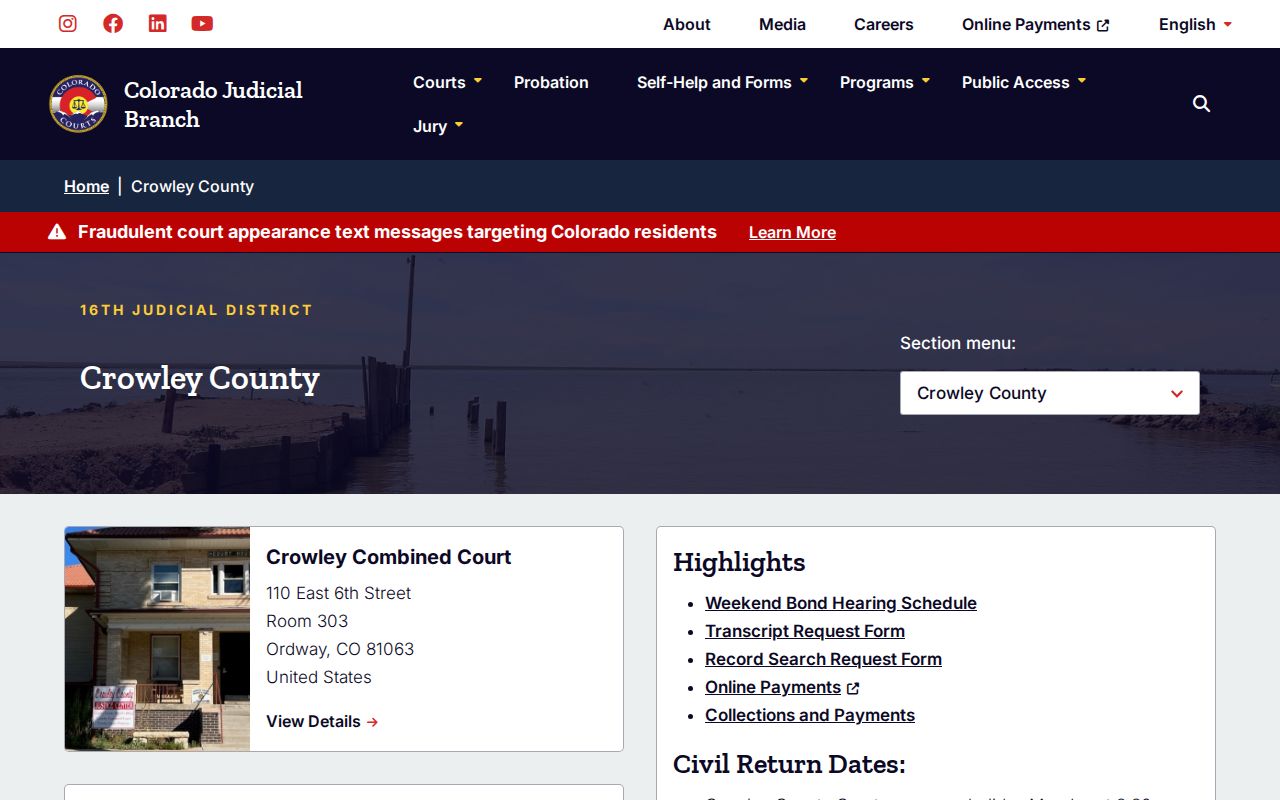
The Crowley Combined Courthouse
The official court location page places Crowley Combined Court at 110 East 6th Street, Room 303, Ordway. That courthouse is the local route for county and district case records in Crowley County. The Sheriff uses the same East 6th Street civic address, though the offices play different roles: the court issues and recalls orders, while authorized officers execute them. The court's own page carries the public-facing location and contact details, not any private case.
Crowley County Warrants by City
Crowley County has four incorporated towns: Ordway, Olney Springs, Sugar City, and Crowley. None of the four runs a dedicated public municipal-warrant portal. Town ordinance matters start with the town clerk or municipal court, while county and district cases go through Crowley Combined Court. The 2020 Census counts below offer civic context only and imply nothing about warrant volume.
Ordway
2020 population 1,066 · County-seat route for the combined court and Sheriff.
Olney Springs
2020 population 315 · Town-office clerk route; no public warrant portal found.
Sugar City
2020 population 259 · Municipal-court structure confirmed in the town code.
Crowley
2020 population 166 · Municipal questions begin with the town office.